About Maslow's Peak
Maslow's Peak is a collection of essays and articles. On the blog page, I explore social issues and public policy from a liberal perspective. The home page provides brief updates on current events, with quick links to related stories. On the "note to self" page, I reflect on my personal process as a political writer; finding the work/life balance, the emotional/intellectual balance, and the outrage/optimism balance.
Comments on any page or issue are enthusiastically welcomed. You will find a comments option at the end of each blog post. For general questions or private comments, use the form on this page.
Welcome, and thank you for your interest!
Comments on any page or issue are enthusiastically welcomed. You will find a comments option at the end of each blog post. For general questions or private comments, use the form on this page.
Welcome, and thank you for your interest!
What does the name "Maslow's Peak" mean?
The name of the website comes from my philosophy that individuals and society can evolve towards ideals together, in mutually beneficial patterns.
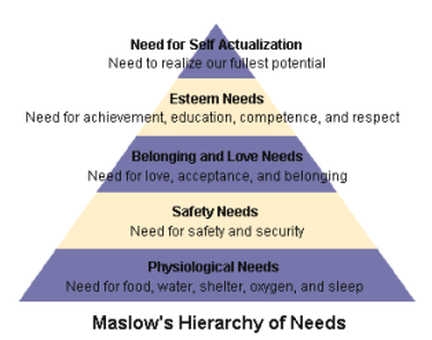
Mid-20th century psychologist Abraham Maslow believed that once our basic needs are met, we are each naturally driven to realize our full human potential. In his Hierarchy of Needs theory, he proposed that we are always concerned first with survival. We must spend energy foremost on ensuring that we are fed, clothed, and safe. If our physical selves are in constant or intermittent jeopardy, we are consumed with practical problem-solving. But once there is an established baseline of material nourishment and adequate shelter, according to Maslow, we intuitively shift focus to more complex needs.
He believed we then move towards the work of developing reliable, supportive relationships. We want to regularly engage in the giving and receiving of love. We want to be a part of some sort of community. And, according to this philosophy, the successful development of substantive trust in the people around us can act as another building block towards what he called self-actualization, seen as the pinnacle of this process of personal growth.
In the next step, once we feel we can rest on the support of others, we become excited about things like sharpening our individual talents, and making a unique contribution. We find satisfaction in taking on more responsibility, like developing and completing projects, or managing group endeavors. A growing confidence in these areas, Maslow reasoned, leads to even more growth.
At that point, we begin to self-actualize. We are drawn to pursue deeper knowledge and insight. We seek wisdom. We experience awe and wonder. We see ourselves through an increasingly wider lens, part of something beyond self, family, community, tribe - a part of the world, a part of the universe. Maslow's philosophy describes a peak at which we perceive a reality that is greater than the sum of its parts. Perhaps that means the majesty of science, perhaps the divinity of love, or both, or something else altogether.
The theory says that there is a natural progression in human development to move from mere existence to what Maslow called the state of "Being".
I wholeheartedly believe in this theory, and have experienced it over and over myself. I don't think it is a wholly linear process, straight up to the peak, but something more complicated. I believe that our steps in this process vary at times, according to things like our health, our economic stability, or simply our age. When we are very young, for example, we may only need to be two or three steps up the pyramid to feel satisfied. Of course, interestingly, that is a time when we are reliant on others to see to it that the first couple levels of need are met.
Indeed, I feel sure we make movements up and down the pyramid throughout our lives. Importantly, throughout these fluctuations, I believe that those who are most able to conceptualize the top of the peak, even in periods of mucking around in the subsistence levels, will ultimately make their way up all the farther.
Most important to me, in terms of my work, is my belief that even as we work as individuals to climb to the peak, society can engage in the same pursuit. I believe if we are able as a group to grow ever more certain of reliable access to food, shelter, and physical safety, we will be freed up to put our energy into developing and improving society. I believe if we all feel fully provided for, we will naturally desire mutual gain, and eventually a shared sense of fulfillment. This fulfillment can be attained in countless ways, including individual pursuit of business success, or art, or medicine, or technological innovation. It might be in a trade or as a parent. But ideally we would all have our survival needs met, and be able to go on to pursue the goals that allow us to make a contribution back to society.
I believe that the achievement of synchronicity between the individual and society is important and attainable. As individuals receive support from society, they are better able to contribute to the whole, pouring resources back in. The society is then all the richer, and has more to provide the individual. There is no contradiction between this concept and the ideal of individual achievement. Rather, the two complement each other. Ultimately, we have nothing to fear from either individual greatness, or from societal wholeness and functionality.

He believed we then move towards the work of developing reliable, supportive relationships. We want to regularly engage in the giving and receiving of love. We want to be a part of some sort of community. And, according to this philosophy, the successful development of substantive trust in the people around us can act as another building block towards what he called self-actualization, seen as the pinnacle of this process of personal growth.
In the next step, once we feel we can rest on the support of others, we become excited about things like sharpening our individual talents, and making a unique contribution. We find satisfaction in taking on more responsibility, like developing and completing projects, or managing group endeavors. A growing confidence in these areas, Maslow reasoned, leads to even more growth.
At that point, we begin to self-actualize. We are drawn to pursue deeper knowledge and insight. We seek wisdom. We experience awe and wonder. We see ourselves through an increasingly wider lens, part of something beyond self, family, community, tribe - a part of the world, a part of the universe. Maslow's philosophy describes a peak at which we perceive a reality that is greater than the sum of its parts. Perhaps that means the majesty of science, perhaps the divinity of love, or both, or something else altogether.
The theory says that there is a natural progression in human development to move from mere existence to what Maslow called the state of "Being".
I wholeheartedly believe in this theory, and have experienced it over and over myself. I don't think it is a wholly linear process, straight up to the peak, but something more complicated. I believe that our steps in this process vary at times, according to things like our health, our economic stability, or simply our age. When we are very young, for example, we may only need to be two or three steps up the pyramid to feel satisfied. Of course, interestingly, that is a time when we are reliant on others to see to it that the first couple levels of need are met.
Indeed, I feel sure we make movements up and down the pyramid throughout our lives. Importantly, throughout these fluctuations, I believe that those who are most able to conceptualize the top of the peak, even in periods of mucking around in the subsistence levels, will ultimately make their way up all the farther.
Most important to me, in terms of my work, is my belief that even as we work as individuals to climb to the peak, society can engage in the same pursuit. I believe if we are able as a group to grow ever more certain of reliable access to food, shelter, and physical safety, we will be freed up to put our energy into developing and improving society. I believe if we all feel fully provided for, we will naturally desire mutual gain, and eventually a shared sense of fulfillment. This fulfillment can be attained in countless ways, including individual pursuit of business success, or art, or medicine, or technological innovation. It might be in a trade or as a parent. But ideally we would all have our survival needs met, and be able to go on to pursue the goals that allow us to make a contribution back to society.
I believe that the achievement of synchronicity between the individual and society is important and attainable. As individuals receive support from society, they are better able to contribute to the whole, pouring resources back in. The society is then all the richer, and has more to provide the individual. There is no contradiction between this concept and the ideal of individual achievement. Rather, the two complement each other. Ultimately, we have nothing to fear from either individual greatness, or from societal wholeness and functionality.
About me:
(my family and hangouts)
(my background and beliefs)
I am a writer living in Raleigh, NC. The bulk of my work centers on poverty, racism, and other social issues in the US. I have always been drawn to these issues, maybe because I have lived in shifting socioeconomic circumstances, and in culturally diverse social and familial settings. At a glance, I am a middle-aged, middle-class, white, married, mother of three. I drive my red Sentra to the library, the Farmer's Market, the coffee shop, and the dog-park. I go to the beach in the summer, I vote, I volunteer in the community, and use a bank card for purchases. I probably come across as well-educated, and my social skills are well-developed. I can point to many years of professional experience in interesting fields. Many of my friends have advanced degrees in various fields. I enjoy all the intangible benefits of these cultural codes. The only thing I don't do is garden.
But most of my direct life experience has involved a struggle to make ends meet. There have been countless times over the years when I have been uncertain whether we'd be able to make the rent, keep the lights on and properly feed the kids. We have never had savings or good credit. We have often been without health insurance, using clinics and the ER for medical care. At times of crisis, we managed to stay on solid ground only due to assistance in one form or another.
My husband William and I, and our three kids, have always worked hard. I started working in earnest as a babysitter at age 13, then held cashier jobs all through school, then worked as a child-care provider while raising my own kids, and have done the usual stints in restaurants and bookstores. I've also been fortunate to find work in human services positions that didn't require degrees.
My husband has worked non-stop his whole life as well. Neither of us finished college, and we were very young when we started our family. He did his time in the minimum-wage world too, but fortunately his father had taught him the trade of house-painting, and he has used his talent and hard work in that field to support a family for over 25 years.
Our kids worked as soon as they were legally able, and kept various jobs throughout their schooling as well. They are all in their 20's now, and successfully pursuing their various paths.
But we've always teetered on that thin line between lower middle-class and poor. We have experienced eviction, dependency on public assistance, lack of transportation, rented furniture, bounced checks, collections, leaky and bug-ridden homes, no family doctor, empty cupboards, and all the fear and depression that goes along with those things. Things have improved, but we've never quite eased into what I consider the solid middle-class realm, with advantages like health and life insurance, retirement plans, savings, available credit, paid vacation or sick time, or home ownership. Of course now in the current climate, there are so many who had those things and lost them, hopefully temporarily.
But I never had them. I was born broke, and never seemed able to get beyond that, and I think that fact, as well as the family and friendship ties I have in the lower economic classes, creates some affinity for me with the very poor.
I grew up in the Midwest in the sixties, part of a German/Irish-Catholic family of eight. We never had enough money, and I think that became a part of who I am. I've never felt upwardly mobile. Our parents went to college, but we weren't pushed to do so. It probably just didn't seem feasible, so there was never a sense that we were expected to go. I think I took on an identification as just not being someone who could have a solid financial foundation. So once I got into my twenties, I found myself going through some bad stuff and not really knowing why I couldn't get out of it. I definitely came to understand how our economic system is set up. If you start at or near the bottom, the decks are absolutely stacked against you.
But like a lot of people with a tough past, I ultimately experience this history as enriching. Although there was some dysfunction in my family during my childhood, I treasure the fact that I was raised in a very liberal home, with parents who taught me to think critically and be involved in causes that benefit everyone, not just myself. I set out in life knowing I would be doing myself a favor to stay open to all kinds of people, and that has been my creed. The footing that was provided to me by my parents, though not financial, was solid. It had to do with how to look at the world. How to evaluate politics and society, how to always be aware of things like prejudice, racism and injustice, and how important it is to actively participate in the processes of democracy.
From the time I was very young, our home was filled with people of all colors and backgrounds. In that environment I repeatedly experienced relationships of deep trust and affection with family friends of different races. This naturally expanded into interracial childhood friendships, and as I got older, I had a deep sense of freedom about who I would depend on as my closest friends, and who I would date. I never felt marshaled into a narrow slot by family expectations or my own comfort level.
The man I eventually fell in love with and married is black. Obviously that means our kids are biracial, and that our extended family is especially diverse - we have huge families on both sides, so there is quite a mix of cultures and experiences that go into our family life. It is incredibly rich and constantly makes me feel so lucky. I can't imagine what my life would be like if I had felt some hesitation when I met my husband, because I am white and he is black.
I already had a mindset that held a heightened awareness of societal issues, and a sensitivity to institutionalized barriers, because of my low income. Going through life as part of a family of color, frequently facing ignorance and hostility about race, my commitment to progressive ideas continued to take shape.
In my late 20's I began a decade of work at the CDC National AIDS Hotline, and my world continued to expand. The gay and lesbian friends and colleagues I met through my work there remain some of the dearest, most important people in my life. Over those ten years I became deeply immersed in the riveting work of the hotline. I also was drawn to participation in outside political activism related to AIDS treatment and gay rights, and I found incredibly gratifying social connections as well. The years I spent at the hotline shaped my priorities and enriched my life immeasurably.
The final piece that shaped the passions I have now was my work in the public school system. For several years in my forties, I worked as a teacher assistant in programs that serve kids with severe behavioral problems. These kids were so unable to operate successfully in a regular classroom that they were pulled long-term into a separate setting. We worked with them to identify root causes of their behavior problems and help them learn to succeed. These behavior patterns were entrenched, and came from a variety of causes, including learning disabilities and mental disorders. But it didn't take me long to observe that the vast majority of the students referred to our program were black kids, mostly boys, from very poor homes in tough, crime-ridden, unstable neighborhoods. Anyone who has ever worked with families living in that kind of setting knows that the harder you try to look for solutions, the more clearly you see the size of the problems and their chronic, complicated, multi-generational nature. It becomes brutally obvious that our social and economic systems themselves are complicit in failing these kids. In these neighborhoods, the odds against any one individual or family transcending their circumstances can be dismal.
But not impossible. And for me, the steps to this transcendence of circumstances, the steps that help the people stuck at the bottom to make their way towards the peak, are steps most often taken by progressive people devoted to curing social ills, devoted to inclusion and empowerment, and devoted to seeing to it that everyone has an equal opportunity to succeed.
So what drives me now is my commitment to the progressive ideal. In concrete, specific, sociopolitical terms, I am a staunch liberal, a proud Democrat, a big supporter of President Barack Obama, an enthusiastic proponent of LGBT equality, a proactive opponent of racism, and a willing class warrior. The fight for equality for all races, belief systems, sexual orientations, and income levels is not a quaint utopian concept. If there is anything we've learned in US history, it's that inclusion improves us, and equality is indispensable. We can't allow those who resist social progress to frame these ideas as though they are optional, flawed, dangerous, or inconsistent with either capitalism or democracy. Individual achievement and the good of the whole are not in conflict. The balance between the two is what we must strive for, and our Constitution was presciently written to protect both. The riches we reap from not just tolerating but embracing and promoting diversity are incalculable.
What gets me up in the morning is thinking about these issues, writing about them and hopefully occasionally persuading someone to see their value.
Thank you for stopping by Maslow's Peak, and please visit often!
But most of my direct life experience has involved a struggle to make ends meet. There have been countless times over the years when I have been uncertain whether we'd be able to make the rent, keep the lights on and properly feed the kids. We have never had savings or good credit. We have often been without health insurance, using clinics and the ER for medical care. At times of crisis, we managed to stay on solid ground only due to assistance in one form or another.
My husband William and I, and our three kids, have always worked hard. I started working in earnest as a babysitter at age 13, then held cashier jobs all through school, then worked as a child-care provider while raising my own kids, and have done the usual stints in restaurants and bookstores. I've also been fortunate to find work in human services positions that didn't require degrees.
My husband has worked non-stop his whole life as well. Neither of us finished college, and we were very young when we started our family. He did his time in the minimum-wage world too, but fortunately his father had taught him the trade of house-painting, and he has used his talent and hard work in that field to support a family for over 25 years.
Our kids worked as soon as they were legally able, and kept various jobs throughout their schooling as well. They are all in their 20's now, and successfully pursuing their various paths.
But we've always teetered on that thin line between lower middle-class and poor. We have experienced eviction, dependency on public assistance, lack of transportation, rented furniture, bounced checks, collections, leaky and bug-ridden homes, no family doctor, empty cupboards, and all the fear and depression that goes along with those things. Things have improved, but we've never quite eased into what I consider the solid middle-class realm, with advantages like health and life insurance, retirement plans, savings, available credit, paid vacation or sick time, or home ownership. Of course now in the current climate, there are so many who had those things and lost them, hopefully temporarily.
But I never had them. I was born broke, and never seemed able to get beyond that, and I think that fact, as well as the family and friendship ties I have in the lower economic classes, creates some affinity for me with the very poor.
I grew up in the Midwest in the sixties, part of a German/Irish-Catholic family of eight. We never had enough money, and I think that became a part of who I am. I've never felt upwardly mobile. Our parents went to college, but we weren't pushed to do so. It probably just didn't seem feasible, so there was never a sense that we were expected to go. I think I took on an identification as just not being someone who could have a solid financial foundation. So once I got into my twenties, I found myself going through some bad stuff and not really knowing why I couldn't get out of it. I definitely came to understand how our economic system is set up. If you start at or near the bottom, the decks are absolutely stacked against you.
But like a lot of people with a tough past, I ultimately experience this history as enriching. Although there was some dysfunction in my family during my childhood, I treasure the fact that I was raised in a very liberal home, with parents who taught me to think critically and be involved in causes that benefit everyone, not just myself. I set out in life knowing I would be doing myself a favor to stay open to all kinds of people, and that has been my creed. The footing that was provided to me by my parents, though not financial, was solid. It had to do with how to look at the world. How to evaluate politics and society, how to always be aware of things like prejudice, racism and injustice, and how important it is to actively participate in the processes of democracy.
From the time I was very young, our home was filled with people of all colors and backgrounds. In that environment I repeatedly experienced relationships of deep trust and affection with family friends of different races. This naturally expanded into interracial childhood friendships, and as I got older, I had a deep sense of freedom about who I would depend on as my closest friends, and who I would date. I never felt marshaled into a narrow slot by family expectations or my own comfort level.
The man I eventually fell in love with and married is black. Obviously that means our kids are biracial, and that our extended family is especially diverse - we have huge families on both sides, so there is quite a mix of cultures and experiences that go into our family life. It is incredibly rich and constantly makes me feel so lucky. I can't imagine what my life would be like if I had felt some hesitation when I met my husband, because I am white and he is black.
I already had a mindset that held a heightened awareness of societal issues, and a sensitivity to institutionalized barriers, because of my low income. Going through life as part of a family of color, frequently facing ignorance and hostility about race, my commitment to progressive ideas continued to take shape.
In my late 20's I began a decade of work at the CDC National AIDS Hotline, and my world continued to expand. The gay and lesbian friends and colleagues I met through my work there remain some of the dearest, most important people in my life. Over those ten years I became deeply immersed in the riveting work of the hotline. I also was drawn to participation in outside political activism related to AIDS treatment and gay rights, and I found incredibly gratifying social connections as well. The years I spent at the hotline shaped my priorities and enriched my life immeasurably.
The final piece that shaped the passions I have now was my work in the public school system. For several years in my forties, I worked as a teacher assistant in programs that serve kids with severe behavioral problems. These kids were so unable to operate successfully in a regular classroom that they were pulled long-term into a separate setting. We worked with them to identify root causes of their behavior problems and help them learn to succeed. These behavior patterns were entrenched, and came from a variety of causes, including learning disabilities and mental disorders. But it didn't take me long to observe that the vast majority of the students referred to our program were black kids, mostly boys, from very poor homes in tough, crime-ridden, unstable neighborhoods. Anyone who has ever worked with families living in that kind of setting knows that the harder you try to look for solutions, the more clearly you see the size of the problems and their chronic, complicated, multi-generational nature. It becomes brutally obvious that our social and economic systems themselves are complicit in failing these kids. In these neighborhoods, the odds against any one individual or family transcending their circumstances can be dismal.
But not impossible. And for me, the steps to this transcendence of circumstances, the steps that help the people stuck at the bottom to make their way towards the peak, are steps most often taken by progressive people devoted to curing social ills, devoted to inclusion and empowerment, and devoted to seeing to it that everyone has an equal opportunity to succeed.
So what drives me now is my commitment to the progressive ideal. In concrete, specific, sociopolitical terms, I am a staunch liberal, a proud Democrat, a big supporter of President Barack Obama, an enthusiastic proponent of LGBT equality, a proactive opponent of racism, and a willing class warrior. The fight for equality for all races, belief systems, sexual orientations, and income levels is not a quaint utopian concept. If there is anything we've learned in US history, it's that inclusion improves us, and equality is indispensable. We can't allow those who resist social progress to frame these ideas as though they are optional, flawed, dangerous, or inconsistent with either capitalism or democracy. Individual achievement and the good of the whole are not in conflict. The balance between the two is what we must strive for, and our Constitution was presciently written to protect both. The riches we reap from not just tolerating but embracing and promoting diversity are incalculable.
What gets me up in the morning is thinking about these issues, writing about them and hopefully occasionally persuading someone to see their value.
Thank you for stopping by Maslow's Peak, and please visit often!